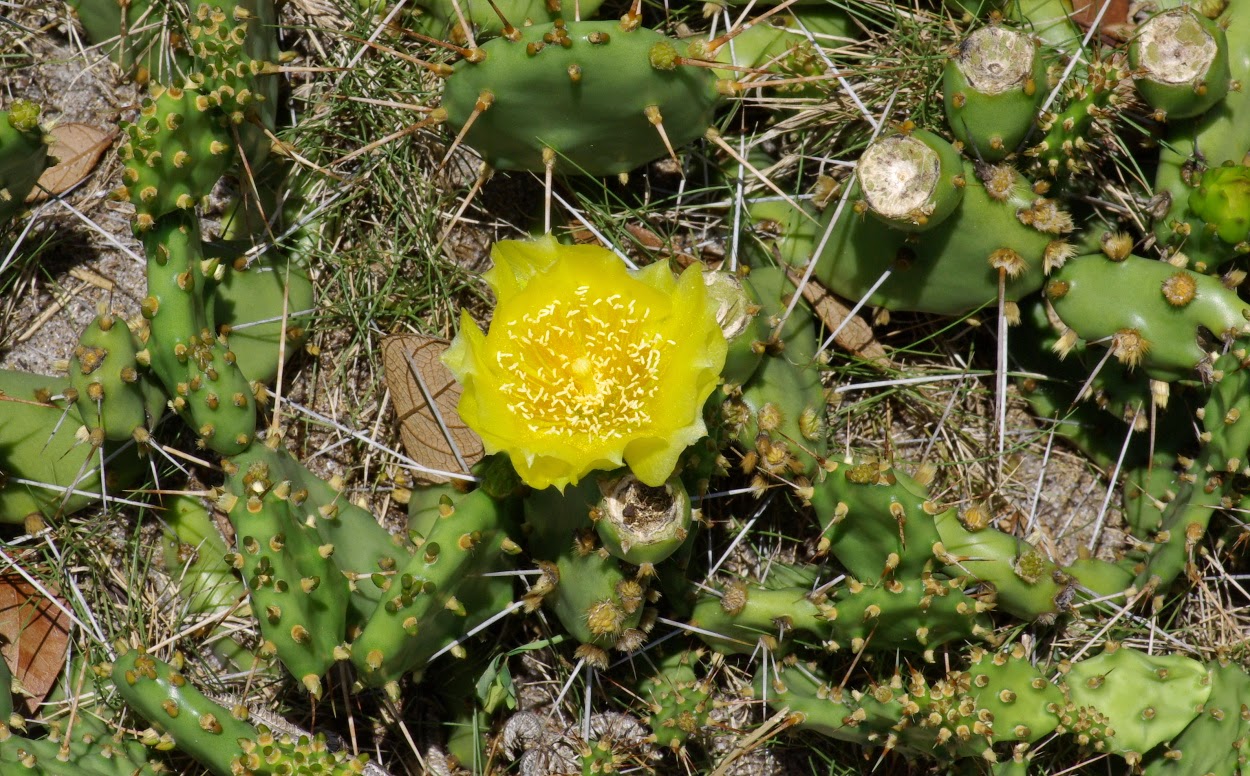
Note: This article was originally titled Opuntia triacanthos; however, molecular genetic analysis by L.C. Majure (2012) indicated that it cannot be O. triacanthos because the Florida plants fall into a separate clade than does O. triacanthos from the Caribbean. Majure's research showed that O. abjecta is a distinct species originally distinguished by John Kunkel Small.
Opuntia abjecta is a Florida state-listed endangered species, under the misapplied name of O. triacanthos, that is remarkable for its small size and it slowly forms low mounds that will cover about two square feet and reach 3–6 inches in height in a few years. Previously, Florida's population was thought to be an outlier of the Caribbean species, O. triacanthos. But it is now known to be a distinct species, first recognized by John Kunkel Small, that is endemic to the Monroe County Keys.
The pads are very weakly attached to one another and this, in combination with the barbed spines, means that they will almost leap onto the shoes, clothing, or fur of anyone or anything that brushes against the plant. Thus, it should not be situated where animals or people will pass nearby. This is not only for the benefit of passersby, but for the plant itself since the frequent loss of pads causes the clumps to fall apart and they will not flower as freely as undisturbed clumps.
This interesting miniature succulent is well worth growing in succulent plant collections. If one lacks a garden, it can be grown as a potted plant, and I have flowered it in a 3-inch pot on a south-facing windowsill.
Majure, L.C. 2012. The Evolution and Systematics of the Opuntia humifusa Complex. University of Florida doctoral dissertation. 10 May 2015.
© 2009, 2015 Rufino Osorio. All rights reserved.