Sunday, February 17, 2013

Zeuxine strateumatica – Lawn Orchid

Zeuxine strateumatica; Lawn Orchid; Soldier Orchid
Zeuxine strateumatica growing in a lawn and living up to its common name, lawn orchid.

Zeuxine strateumatica is a small orchid native to tropical and warm-temperate regions of Asia. It is now well established elsewhere, including Puerto Rico, much of Florida, and parts of Georgia, Hawaii, Louisiana, and Texas. It readily grows in lawns and in landscaped areas covered with bark mulch. It appears to be naturally short-lived and is very difficult to transplant from the ground into a pot; however, if seed is gathered up when ripe in the spring and scattered among potted plants, a few lawn orchids will usually show up in the pots the following winter or spring.

Image and text © 2013 Rufino Osorio

Bourreria radula – Rough Strongbark

Bourreria radula; Rough Strongbark


Rough strongbark is a Florida state-listed endangered plant with significant wildlife value. It is a large shrub or small tree with small, dark green leaves whose upper surface has coarse, rough hairs that give the leaves a sandpaper-like texture. Attractive and sweetly fragrant white flowers are borne nearly year around and these are much sought after by various insects, including bees and butterflies. The flowers are followed by rather large, highly ornamental, orange berries that are eaten by birds, raccoons, opposums, and other animals.

Rough strongbark occurs as a native plant in Florida only in the Florida Keys but it can be grown at least as far north as Palm Beach County and probably much further north if it is not grown too far from the moderating influence of the Atlantic Ocean or the Gulf of Mexico. Its cultivation presents few problems so long as it is provided with well-drained rocky or sandy soil and abundant sunlight. Once established, rough strongbark is extremely drought tolerant and even small plants have readily established themselves in the driest part of my garden. Propagation from cuttings and seeds is difficult; however, with time, numerous self-sown seedlings will appear under mature plants and these can be potted up when they are a few inches high. Since rough strongbark readily sprouts from the roots wherever the roots are cut or injured, it can probably also be propagated from root cuttings.

Rough strongbark is extremely tolerant of hot, dry conditions and poor, alkaline soils. Thus, it is useful as a landscape plant or hedge in difficult urban situations such as roadsides and parking lots. The abundant fruits falling on sidewalks can make quite a mess and it is not recommended as a residential street tree, although it is otherwise an excellent street tree.

Image and text © 2013 Rufino Osorio

Bastardiopsis eggersii – Jost Van Dyke's Indian-Mallow

Abutilon virginianum; Bastardiopsis eggersii; Sida eggersii; Jost Van Dyke's Indian-Mallow

Jost Van Dyke's indian-mallow is a highly endangered Caribbean shrub or small tree known from three islands in the British Virgin Islands and one island off the coast of Puerto Rico. An article by Fred Kraus provides very detailed information about this rare plant. The image above is of a young plant growing in a private garden in Fort Lauderdale, Florida. The plant is surrounded by numerous seedlings of black ironwood (Krugiodendron ferreum). The genus to which Jost Van Dyke's indian-mallow belongs has been a matter of some controversy and it is sometimes found listed as Abutilon virginianum or as Sida eggersii.

Plants in my garden flower in early spring (January in south Florida). The flowers are tiny but are attractive to bees and are rather pretty when examined closely.


Images and text © 2013 Rufino Osorio

Antigonon leptopus – Coral Vine

Warning: Antigonon leptopus is listed as a Category 2 invasive pest plant by the Florida Exotic Pest Plant Council. It is included here only as an aid to identification and not to promote its cultivation in any way whatsoever.

Antigonon leptopus; Coral Vine

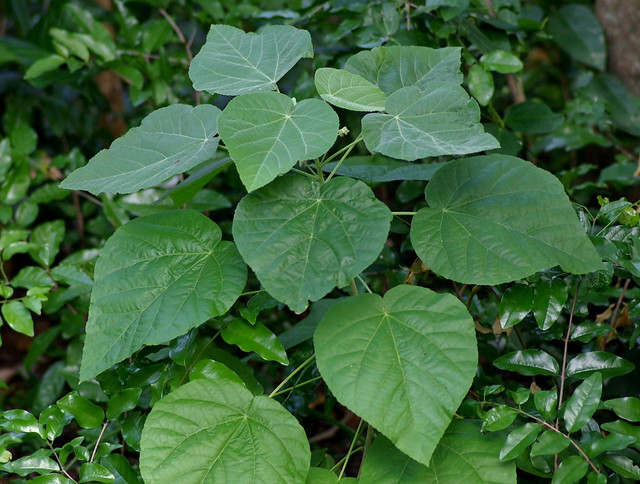
Coral vine, Antigonon leptopus, is a vigorous, long-lived, evergreen, tendril-climbing vine native to Mexico and possibly also to western Guatemala. It grows from large, tuberous roots and is extremely difficult to eradicate since any piece of the tubers left in the ground can produce a new plant. It is capable of tolerating extreme adversity, such as prolonged drought, once it is established since it will die back to the ground and sprout new stems once conditions have ameliorated. The heart-shaped leaves are deeply veined and the plant bears pretty pink, or rarely white, flowers during the warmer months of the year, or nearly year around in warm climates.

Coral vine grows aggressively and can produce a smothering blanket over trees as high as 40 feet. It is usually found in disturbed sites but is occasionally found along the edges of forests, where it tolerates a wide range in the level of light and soil moisture. The image shows a plant that is established behind the nature center building at Okeeheelee County Park in Palm Beach County, Florida. Nearly all of the foliage in the image belongs to a non-native Dioscorea species (wild yam), probably Dioscorea alata, which is another non-native vine that is listed as invasive in Florida. Also visible in the image is the foliage of the native shrub, myrsine (Myrsine cubana), and the native vine, wild grape (Vitis rotundifolia).

Image and text © 2013 Rufino Osorio

Pineland Lobelia – Lobelia homophylla

Pineland Lobelia - Lobelia homophylla

Pineland lobelia is a an annual lobelia that is endemic to Florida and has been recorded in St. Johns County in north Florida from where it ranges south to Collier County on Florida's west coast and to St. Lucie County on Florida's east coast. In the spring of 2005, a single plant was established from a cutting given to me by a native plant acquaintance. The cutting was collected from plants growing in a ditch in Martin County and these plants constituted a new county record since the Atlas of Florida Vascular Plants does not list pineland lobelia as occurring in Martin County. I rooted the cutting and, in due course, it flowered and set seed. The seed was broadcast among several potted native plants and a colony of pineland lobelia has thrived at my home ever since.

Pineland Lobelia - Lobelia homophylla
Seedling pineland lobelias growing in cracks in my driveway.

Innumerable plants now come up every year in my potted plants, as well as in cracks in my driveway and in my wildflower beds. Pineland lobelia grows best in open, sunny, moist areas but it will also grow in light to medium shade. In drier spots, it behaves as a winter annual but, if there is sufficient moisture, it will grow year around. Seeds germinate vigorously with the arrival of cool autumn weather and seeds are the most effective way of propagating pineland lobelia. As I mentioned above, it can be grown from cuttings but plants produced from cuttings do not develop normally since they have a tendency to devote all of their energy to flowering and soon seed themselves to death.

Pineland Lobelia - Lobelia homophylla

Pineland lobelia has limited wildlife value but it is useful for adding a bit of blue color to wildflower gardens as well attracting native bees and honeybees to the garden. So far, it has not been bothered by pests and its only major fault is that it is an annual that dies after flowering. Thus, it is important to let it go to seed and to provide open, moist areas where it can grow without competition from taller and more aggressive plants. Pineland lobelia can be mistaken for bay lobelia (Lobelia feayana) but pineland lobelia grows from a loose rosette and has erect stems whereas bay lobelia has creeping vegetative stems that root wherever they touch the ground.

Pineland Lobelia - Lobelia homophylla

Images and text © 2013 Rufino Osorio

Monday, December 10, 2012

Corchorus siliquosus – Slippery Burr

Corchorus siliquosus - Slippery Burr - Broomweed
Corchorus siliquosus bears an elongated capsule with four toothlike appendages at its apex (note the unripe capsule in the lower left side of the image).

Slippery burr, Corchorus siliquosus, is a native short-lived perennial or subshrub recorded from south Florida in Collier, Miami-Dade, and Monroe counties, including the Florida Keys. It is an inconspicuous plant due to its thin, erect stems with short side branches and small leaves and it tends to blend in with the surrounding vegetation. Although normally growing 1–3.3 feet (0.3–1.0 meters) tall, it can flower and set seed when only a few inches tall. At about 0.4 inches (10 millimeters) wide, the flowers are too small to make a showy display but they are extremely attractive due their brilliant yellow color and numerous stamens. The flowers are ephemeral, opening around 2:00 or 3:00 P.M. and closing the next morning, but large, healthy plants will produce numerous flowers over a long period in the summer and extending into autumn or winter. The flowers are soon followed by elongated capsules 2–3 inches (5–8 centimeters) long filled with numerous small black seeds. Unfortunately, the charms of Corchorus siliquosus in flower are soon diminished by the conspicuous, numerous, and rather unsightly seed capsules. However, since plants tend to decline after a year or two, gardeners must let it go to seed if they wish to have it persist from one year to the next.

Corchorus siliquosus is a somewhat weedy plant of open, disturbed sites. This is both good and bad as far as its cultivation is concerned. It is a good thing because, like most weedy plants, it is very easily cultivated in just about any sunny spot with well-drained soil. It is bad because it produces a prodigious number of self-sown seedlings and can soon overtake a large sunny garden bed if larger or more aggressive plants are not present to keep it in check. In spite of its weedy nature, I enjoy its little flowers in the late summer and autumn garden, where they shine with a fiery glow on crisp, clear, sunny afternoons and thus always keep one or two plants going in the yard. Propagation presents few problems and Corchorus siliquosus may be easily grown from cuttings. It is also easily propagated from seeds but patience is sometimes required since the seeds can sometimes be slow and erratic in their germination.

There are three other species of Corchorus in Florida, one other native and two that have been introduced from the tropics. Corchorus siliquosus is distinguished from all other species in Florida by its long seed capsules that abruptly end in four small, toothlike protuberances at the apex. Corchorus siliquosus is a plant of the North American tropics from southern Florida and the West Indies as well as from Mexico to Panama. Although today it is regarded as native to Florida, John Kunkel Small regarded it as naturalized from the West Indies. There is a possibility that both views are correct with plants in the Florida Keys and Everglades National Park being native and those from disturbed ruderal sites elsewhere in Florida representing inadvertent introductions resulting from human activities.

Image and text © 2012 Rufino Osorio

Monday, November 26, 2012

Solanum tuberosum – Potato

Solanum tuberosum - sprouting potato tuber

I kept two potatoes too long in the fridge and they began to sprout. This past weekend, I planted them in the yard to see what happens. Most likely a horde of Florida fungi, nematodes, and insects will put a quick end to them; however, I might get lucky and get a chance to add the photographs of a potato plant and its flowers to my collection of plant images.

Image and text © 2012 Rufino Osorio

Monday, November 19, 2012

Symphyotrichum georgianum – Georgia Aster

Symphyotrichum georgianum - Georgia aster
This exceptionally deep violet-purple form of the Georgia aster is the cultivar 'N3 Purple Haze'.

Georgia aster (Symphyotrichum georgianum) is a colonial, rhizomatous perennial with flowering stems 1.5–3 feet (50–100 centimeters) tall. It is listed by the USDA as occurring in Alabama, Florida, Georgia, Louisiana, North Carolina, and South Carolina. In Florida, it is a rare plant that is listed as occurring only in Leon County by the Atlas of Florida Vascular Plants.

On March 17, 2006, I acquired a small plant of the deep violet-purple cultivar 'N3 Purple Haze' and planted it in a sunny site in well-drained sandy soil. It quickly spread by way of underground rhizomes to form a patch that covered about 1.5 square feet (0.4572 square meters). To my surprise, the colony has never grown beyond those 1.5 square feet even though there are no obstacles or larger plants preventing its spread. Thus far, it has not been attacked by the aphids, caterpillars, mealy bugs, scales, nematodes, grubs, or viruses that prove so troublesome in south Florida.

Symphyotrichum georgianum - Georgia aster
New stems of Georgia aster emerge in early spring.

Georgia aster flowers abundantly and spectacularly but it is among the last of the wildflowers to bloom in my garden and begins to flower at the end of October or the beginning of November. The only other wildflower in my garden that blooms later are my clones of Symphyotrichum concolor (eastern silver aster) from Miami-Dade County, which do not flower until the end of November or even December. After flowering, the stems dry up and I remove them. Unlike some asters, the stems of Georgia aster tend to recline, or even lie on the ground, with age. Gardeners who desire a more formal appearance can trim back the plant in mid-summer, a treatment that results in shorter, more erect flowering stems.

Like most rhizomatous perennials, Georgia aster is easily propagated by splitting off and potting up new growths in the spring. My single plant has never set viable seed, which indicates that Georgia aster is self-sterile. This year I've acquired a second clone and I'm hoping to obtain viable seed next year. The new clone has flowers of the typical color for the species, deep blue rather than purple-violet, and I'm hoping that, by crossing the two, I will get progeny whose flowers will come in a range of blue, violet, and purple colors. Craig Huegel has images of plants with the typical deep blue flowers at his blog, Native Florida Wildflowers.

Symphyotrichum georgianum - Georgia aster

Images and text © 2012 Rufino Osorio

Sunday, November 18, 2012

Is Lantana depressa Sphingophilous?

Lantana depressa

Lantana depressa is a dwarf, evergreen, short-lived shrub that bears small but numerous bright yellow flowers. It is a state-listed endangered species that occurs only in Miami-Dade County. The flowers are attractive to butterflies and it is sometimes grown as a nectar plant in butterfly gardens.

On Tuesday, November 6, 2012, at approximately 5:30 PM (Eastern Daylight Saving Time) I was at the local Home Depot and noticed a large, brown sphinx moth repeatedly and persistently visiting the flowers of Lantana depressa. I purchased two plants and, after getting them home, I noticed for the first time that the flowers were fragrant. The fragrance was not powerful but it was distinct and clearly noticeable. It was sweet and pleasant but was unlike any other floral scent I have ever experienced. The next day, I tested the flowers to see if they were fragrant during the day but the scent was almost undetectable.

Based on these observations, it appears that Lantana depressa employs a dual pollinating strategy: psychophily (butterfly pollination) during the day and sphingophily (sphinx moth pollination) during the night. The presence of a distinct sweet odor that intensifies at night is a classic sign of sphinx moth pollination. Also, an adaption to sphinx moths as pollinators might explain an important distinction between Lantana depressa and the weedy, non-native, and invasive Lantana camara. The latter has flowers that open up one color and then fade to another. This allows pollinators to readily distinguish fresh, nectar-filled flowers from older flowers as well as creating a more easily noticeable floral display. In Lantana depressa, older flowers do not change color or else become merely a slightly darker shade of yellow. If Lantana depressa is transitioning to or has become adapted to sphinx moth pollination, this would explain the color constancy of the flowers since a difference in color between new and older flowers would not be perceptible to nocturnal sphinx moths.

Before ending this post, I would like to point out another interesting observation made at the Home Depot on November 6. Growing immediately adjacent to the pots of Lantana depressa were numerous cultivars of Lantana camara. The latter bore innumerable fruits in all stages of maturity whereas not a single fruit was to be seen on the plants of Lantana depressa. Although Lantana depressa will cross-breed with, and be genetically swamped by, Lantana camara, it appears as if that particular Home Depot clone of Lantana depressa was both self-sterile and not interfertile with the adjacent clones of Lantana camara.

Image and text © 2012 Rufino Osorio

Cuttings


The image above shows my preferred technique for propagating plants from cuttings. I use small plastic cups that are 2 inches (5 centimeters) wide across the top. After inserting the cutting in the soil, I loosely wrap it up with plastic to maintain high humidity and the cuttings are placed in a frosted east-facing window. This provides bright light, which stimulates the cuttings to root more readily, while avoiding excessive sunlight that would scorch or bake the cuttings. Except for woody, hard-to-root cuttings, I do not use any rooting hormones.

Once the cuttings are well rooted, I'll harden them off by removing the plastic wrap and slowly acclimating them to full sun. Then I'll move them into bigger pots (unlikely) or plant them directly in the ground (much more likely). I prefer to place small cuttings like these into the ground for three reasons. First, the small pots, with their equally small quantities of soil, use up far less resources than larger pots. Second, they are much more easily handled than larger pots and create far less of a disturbance in the garden than does the planting of a larger plant. Lastly, small young plants adjust better to life in my sandy South Florida soils than do large plants. Often, large plants originally flourish but eventually perish when their roots, accustomed to living in a large pot of rich, organic potting soil, fail to adjust to growing in Florida sand. I also like this system because both the plastic pots and the plastic wrap can be reused indefinitely.

For curious readers, the plants above are, from left to right: Plectranthus parviflorus 'Sapphire Dream', which is being rooted in water; two cuttings of Calamintha coccinea (synonym: Clinopodium coccineum); and two cuttings of Piloblephis rigida 'Juniper'. All three are members of the mint family (Lamiaceae). The Plectranthus is a variegated cultivar of a plant originally native to South Africa and Swaziland. The Calamintha is native to Alabama, Florida, Georgia, and Mississippi. The Piloblephis is native to peninsular Florida and the Bahamas. Piloblephis rigida 'Juniper' is a cultivar originating from plants growing wild in Palm Beach County that has a very dense and crawling growth habit with mature plants forming a solid groundcover only a few inches high and resembling a prostrate juniper.

Image and text © 2012 Rufino Osorio