Thursday, September 1, 2011

Elymus – Wild-Rye

Elymus

Above is a landscape image of the Great Kobuk Sand Dunes of Kobuk Valley National Park in Alaska. The image was taken by Michael Compagno while on vacation. The grass seen colonizing the sand dunes is an Elymus species, of which Alaska has quite a few species and most of which have the common name of wild-rye.

Image © 2011 by Michael Compagno, used with permission.

Dryas octopetala – White Mountain Avens

Dryas octopetala - White Mountain Avens


Michael Compagno snapped the images above in Alaska of Dryas octopetala, which is commonly known as white mountain avens. A member of the rose family, it is a plant of cold boreal and arctic regions and it extends south from Alaska through Canada and into the United States by growing down the chain of western mountains. Each tiny, seedlike fruit, technically referred to as an achene, is equipped with a long feathery tail that aids in catching the wind and helps to disperse the seeds to new locations. These images were captured in August and it was the middle of autumn in Alaska. Thus, very few plants were in flower but many were in fruit. If Michael had visited earlier, he would have been greeted by many dozens of pure white flowers, held a few inches off the ground, and resulting in a spectacular display. The flowers face the sun and the petals form a little bowl that concentrates the sun's rays and raises the temperature of the central part of the flower several degrees above the ambient temperature. Thus, keeping its pollinating insects cozy and warm.


USDA Distribution Map

© 2011 Michael Compagno (images) and Rufino Osorio (text) (exclusive of the USDA map).

Saturday, July 2, 2011

Two Giant Dustbowls

There are now two giant dustbowls developing in the eastern hemisphere: one in sub-Saharan Africa, the other in central Asia, western Magnolia, and eastern and northern China. Read more about how overgrazing and goats are changing our planet at the Earth Policy Institute.


© 2010 Rufino Osorio.

Thursday, June 23, 2011

Cypripedium acaule – Pink Lady's Slipper

Cypripedium acaule
 

Michael Compagno, an attorney at the South Florida Water Management District, took this striking photograph of the pink lady's slipper in June of this year while hiking a trail in Isle Royale National Park in Michigan. The plant grows in a wide variety of conditions, from lightly shaded to full sun and from wet to dry. However, it has three absolute requirements: highly acidic soil, freedom from the competition of taller plants, and rather cool summer temperatures. Here it is growing with a rich assemblage of plants that includes Clintonia borealis, Cornus canadensis, Coptis trifolia, and Trientalis borealis.

Image © 2011 by Michael Compagno. All rights reserved. Used with permission.

Saturday, May 7, 2011

Nymphaea odorata

Nymphaea odorata

Nymphaea odorata, the white water-lily, was observed growing in a garden pond at the home of Cecily Hangen in West Palm Beach, Florida, during this year's Palm Beach County Florida Native Plant Society's yard tours. Rob Hopper pointed out that it is among the most fragrant of water-lilies and that many hybrid water-lilies owe their fragrance to this species

Nymphaea odorata is a common aquatic plant with a huge range from Alaska in the north to Central America in the south, as well as the Bahamas, Cuba, and Puerto Rico. Its occurrence in both Cuba and Puerto Rico is unusual since Nymphaea odorata has not been recorded in Hispaniola, the large island comprised of Haiti and the Dominican Republic, which lies between Cuba and Puerto Rico. In the United States, Nymphaea odorata has been recorded from every state except Hawaii, North Dakota, and Wyoming. In Florida, it has been recorded from every county, and is expected to occur in all counties; however, it has not yet been recorded, in the form of herbarium specimens, from Calhoun, Hardee, Indian River, Liberty, Monroe, St. Johns, St. Lucie, Seminole, Suwannee, and Union counties

© 2010 Rufino Osorio.

Tuesday, March 8, 2011

Ipheion uniflorum 'Alberto Castillo'

Ipheion uniflorum 'Alberto Castillo'

Ipheion uniflorum 'Alberto Castillo' is a small, South American bulbous plant in the onion family. Flowers are typically some shade of blue but 'Alberto Castillo' is a robust, large-flowered plant with pure white flowers that was originally collected in Buenos Aires, Argentina. A few bulbs were given to me by Rob Hopper. I grew the bulbs as potted plants but Rob also planted them in the ground, where they grew equally well and freely flowered.


© 2010 Rufino Osorio.

Phacelia divaricata

flowers of Phacelia divaricata

In 2010, I came across seeds for sale of Phacelia purshii, an annual native to Ontario and much of the eastern United States. Since it has showy flowers noted for their distinctively fringed petals, I decided to try to cultivate it and purchased a packet of seeds. Based on the foliage alone, I quickly realized that the seeds were not Phacelia purshii. Upon flowering, the plants keyed out to Phacelia divaricata, a very different species native only to eastern California, from the Klamath ranges, south to the San Francisco Bay region and the inner south coastal ranges.

Seeds germinated readily, the seedlings grew very rapidly, and they quickly flowered. Just as quickly, however, the plants set seeds and died. However, during the several weeks that they were in flower, the plants produced attractive masses of lavender-blue flowers with pale, almost white centers. The petals were marked with translucent patches of tissue and this was unlike anything that I had ever seen in any flower. These translucent patches can clearly be seen in the above image of the flowers.


young seedlings of Phacelia divaricata
Young seedlings of Phacelia divaricata.

I have never seen seeds of Phacelia divaricata for sale under that name and I assume that, like so many native plants, it's charms are overlooked because it does not originate from some far-off exotic land.

References:


© 2010 Rufino Osorio.

Saturday, March 5, 2011

A Visit to the Garden of Michael Manna

On Saturday, February 26, 2011, Ryan Leavengood and I visited the home of fellow Florida Native Plant Society member, Michael Manna. The following is a brief account of that visit.

The variety of plants grown by Michael was amazing but four principal groups stood out in my mind: Florida native plants; carnivorous plants; utilitarian plants such as edible, medicinal, or herbal plants; and a variety of tropical plants, most notably, orchids and bromeliads. One remarkable plant that did not fit any of these categories was a venerable Florida cracker rose that was growing to perfection and had beautiful, dark green foliage unblemished by even a hint of disease or insect damage. Among the utilitarian plants, there were a variety of spinach substitutes, as well as a dwarf everbearing mulberry tree, with the fruits of the latter proving a great delight to Michael's daughter, the 18-month-old Willow.

Michael is perhaps best known for his carnivorous plant collection and he grows a wide variety of butterworts (Pinguicula species) and Asian pitcher plants (Nepenthes species). Also well represented are sundews (Drosera species) and American pitcher plants (Sarracenia species). Unfortunately, at the time of our visit, the American pitcher plants were mostly dormant so we had to content ourselves with admiring the freshly developing flower buds, which promised a bountiful show of blossoms a little later in the year. Also present in Michael's collection of carnivorous plants was the Albany pitcher plant (Cephalotus follicularis), which grows in the vicinity of the town of Albany in southwestern Australia, as well as the rainbow plant (Byblis liniflora), also hailing from Australia and named for its linear leaves bedecked with dewy glands that beautifully glisten in the sunlight.

Although many Florida native trees and shrubs are grown by Michael, the most interesting native plants for me were the numerous native wildflowers that he cultivated. The list is a very long one and included many small, colorful plants that are rarely ever grown by gardeners of any kind, whether focusing on native plants or not. Among these were Polygala lutea (orange milkwort); Dichanthelium species (witchgrasses); Xyris species (yellow-eyed-grasses); and Viola species (wild violets), of which Michael had three different species, this being the largest number I have ever seen in a south Florida garden. Also noteworthy, among so many other noteworthy plants, was a tub of the native yellow-flowered water-lily, Nymphaea mexicana.

The images below represent a small sample of the many beautiful plants Ryan and I observed during our visit:
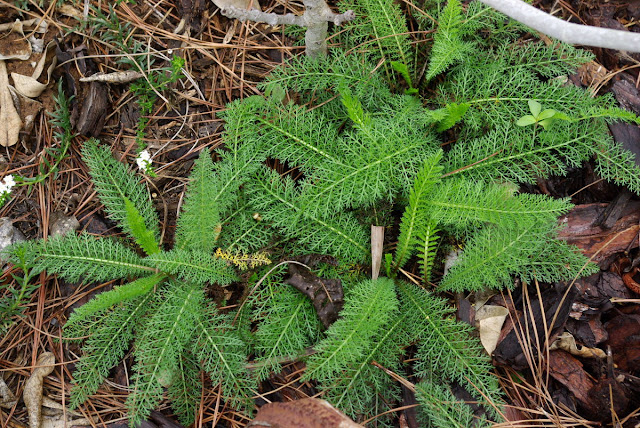
Achillea millefolium - Yarrow
Achillea millefolium (yarrow) is grown for both its ornamental and herbal uses.


Brugmansia
Brugmansia (angel's trumpet).


Cephalotus follicularis - Albany pitcher plant
Cephalotus follicularis, the Albany pitcher plant.


Drosera binata
Drosera binata var. binata, a striking sundew native to Australia and New Zealand.


Drosera burmannii
Drosera burmannii, an annual Asian sundew that readily spreads by way of self-sown seeds.


Greenhouse of Michael Manna
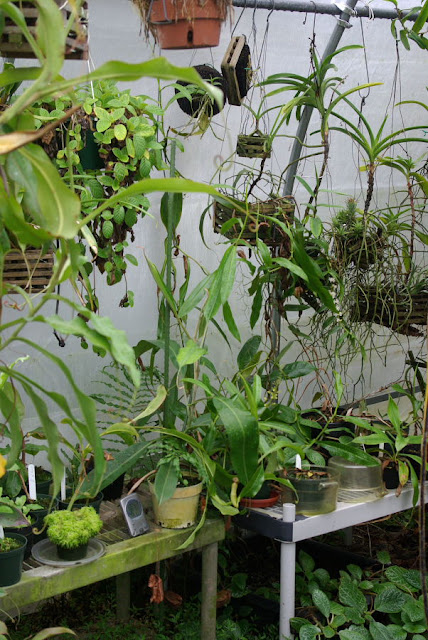
A view of the greenhouse, where most of the Asian pitcher plants are kept.


Pinguicula 'Aphrodite'
Pinguicula 'Aphrodite', a hybrid butterwort whose parents are Pinguicula agnata and Pinguicula moctezumae.


Pinguicula gigantea
Pinguicula gigantea, note the numerous tiny gnats that have been trapped by the plant.


Florida cracker rose
A beautifully grown old fashioned Florida cracker rose.


Tillandsia fasciculata
The native Tillandsia fasciculata, one of many bromeliads in the collection.


Verbesina virginica
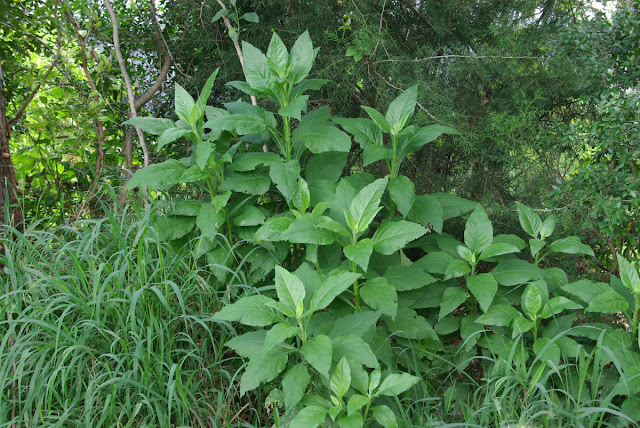
Verbesina virginica, white crownbeard, growing with the native grass, Panicum dichotomiflorum var. bartowense


Viola palmata
Viola palmata has dark violet-purple petals when the flowers first open.


Viola palmata
Viola palmata flowers continue to enlarge, and become more pale, as they age.


© 2010 Rufino Osorio.

Sunday, January 30, 2011

Winding Waters Natural Area

Steve Pisano leads a field trip to Winding Waters Natural Area

On January 29, 2011, approximately 15 members of the Palm Beach Chapter of FNPS went on a field trip to the Winding Waters Natural Area, a 550-acre preserve that protects large areas of pine flatwoods, cypress forests, and marshes, as well as constructed ponds and wetlands. The field trip was lead by Steve Pisano, an Environmental Analyst with the Palm Beach County Department of Environmental Resource Management. Following are a few images from our field trip.

Steve Pisano leads a field trip to Winding Waters Natural Area

Winding Waters Natural Area

Winding Waters Natural Area

Euthamia caroliniana

Heliotropium polyphyllum

Pluchea carolinensis

Dichanthelium species

Gamochaeta pensylvanica


© 2011 Rufino Osorio.

Sunday, January 23, 2011

Pelargonium Caliente® Fire '09

Pelargonium Caliente Fire

Caliente® is a series of Pelargonium hybrids developed by Syngenta for increased heat tolerance. The plants have great hybrid vigor, which results from crossing zonal pelargoniums (Pelargonium × hortorum) with ivy pelargoniums (Pelargonium peltatum). Although touted on various web sites as suitable for the deep south, the Syngenta web site lists the heat tolerance of the Caliente® series as moderate, that is, 70–80° F (21–27° C), which does not appear to be much, or at all, greater than the heat tolerance of typical zonal pelargoniums. Perhaps the plants are being compared, not to zonal pelargoniums, but to regal pelargoniums (Pelargonium × domesticum) and to regular ivy pelargoniums (Pelargonium peltatum), both of which tend to have low heat tolerance. In any event, the Caliente® series can be expected to burn out during south Florida's torrid summers; however, for reasons that are not too clear, when grown in pots the plants tend to be much more heat tolerant than if planted in the ground, especially if protected from the intense afternoon sun.

Fire '09 is a Caliente® cultivar characterized by very dark green leaves and intense tomato-red flowers. Unfortunately, it is all but impossible to capture the true color of its flowers with either film or digital cameras and the above image has an orange tone that is completely lacking when the flowers are viewed by the human eye. Fire '09 is listed by Syngenta as PPAF (plant patent applied for), which precludes its vegetative propagation without a license from Syngenta.


© 2011 Rufino Osorio.