Showing posts with label Okeeheelee County Park. Show all posts

Sunday, January 8, 2012

Okeeheelee County Park Nature Center – Part 2

This is the second part of my photographic tour of the Okeeheelee County Park Nature Center, which I visited on Friday, December 23, 2011. In the first part, I focused on the butterfly garden that surrounds the perimeter of the nature center building. In this second part, I will focus on the plants observed while on the nature trails in the eastern portion of the nature center. The map below shows my route and the numbers correspond to the general location of the numbered entries in this post. The meeting pavilion is labeled No. 1; the nature center building is not visible but it lies a short distance south and west of point No. 2.

Aerial map of the western portion of the Okeeheelee County Park Nature Center
Map imagery ©2011 GeoEye; map data ©2011Google.

Point No. 2 is a very interesting site with many square yards dominated by bracken, Pteridium aquilinum, which is the largest fern native to Palm Beach County. Growing at the periphery of the bracken colony, or sometimes growing with the bracken, are a variety of common native and non-native plants characteristic of disturbed habitats. Some of these include rosary pea, American beautyberry, poison-ivy, Caesar weed, and common tick-trefoil.

Pteridium aquilinum
The densest portions of the bracken colony are a near monoculture of bracken.

Pteridium aquilinum
A close-up of the foliage of the bracken. Note the grape leaf in the lower right hand corner.

Abrus precatorius
Abrus precatorius, rosary pea, is a common invasive pest plant throughout the Okeeheelee County Park Nature Center. Like most non-native pest plants, it has little wildlife value and the conspicuous black and red seeds fool birds into thinking they are eating a juicy berry but they pass undigested without having provided any nutrition to the bird.

Callicarpa americana leaves
Callicarpa americana, American beautyberry, is a tough nearly indestructible native shrub and here we see it thriving while competing with bracken and wild grape.

Toxicodendron radicans leaves with pink galls caused by the poison-ivy leaf gall mite.
Toxicodendron radicans, poison-ivy, is a common plant throughout much of the Okeeheelee County Park Nature Center and is often afflicted with unusual pink galls, these caused by the poison-ivy leaf gall mite, Aculops rhois, a microscopic eriophyid mite.

Urena lobata
Urena lobata, Caesar weed, was originally introduced from east Asia, probably India, as a source of fiber. Due to superior sources of fiber, it is not profitably grown in the United States and it has escaped to become an invasive pest. The small, pretty flowers are borne by a large coarse plant and they are soon followed by unattractive, dry brown fruits that split into five segments that are covered with hooked bristles by which means they tenaciously cling to clothing.

Desmodium incanum foliage
Desmodium incanum, common tick trefoil, is a common weed of lawns, roadsides, vacant lots, and the disturbed portions of natural areas. It was orginally native to the American tropics but now has a pantropical distribution due to dispersal by human activity.

Following the trail to the east, one soon encounters highly disturbed areas along the trail at Point No. 3. Typical of such areas, and one of Palm Beach County's most common native weeds, is the common wireweed or common fanpetals. It is in the mallow family and there is scarcely an empty urban lot in Palm Beach County in which it does not occur.

Sida ulmifolia (previously known as Sida acuta)
Sida ulmifolia, common wireweed or common fanpetals, is often found in older works under the synonym, Sida acuta.

At Point No. 4, one can find button-sage, which is a lantana and not a true sage, and yellow-alder. Neither occurs naturally at Okeeheelee County Park Nature Center and both have escaped after being cultivated at Point No. 1 (the meeting pavilion). I also found a plant of varnish leaf, Dodonaea viscosa, a few yards from Point No. 4, it being yet another example of a plant escaping after being cultivated at the nature center.

Lantana involucrata
Lantana involucrata, button-sage, has pretty tricolored flowers marked with lavender-pink, white, and yellow. It is frequently grown as a nectar plant in butterfly gardens. Although native to the region, it does not naturally occur at the nature center and the plants at Point No. 4 represent escapes from cultivation.

Lantana involucrata
Lantana involucrata, button-sage, has tiny but conspicuous amethyst berries that resemble miniature versions of beautyberry (Callicarpa americana). Note the tiny moth in the upper right hand side of the image.

Turnera ulmifolia
Turnera ulmifolia, yellow-alder, is a non-native plant that was cultivated at the meeting pavilion but has escaped and is growing wild about 25 yards away. Note the foliage of the invasive pest plant, rosary pea (Abrus precatorius), in the background. In the upper right hand corner, one can see the foliage of Chromolaena odorata, and in the lower left hand corner, a single leaf of an unidentified Smilax species is visible.

Points Nos. 5 and 6 puts us in a region of very dry pine flatwoods, as is attested to by the presence of prickly-pear.

Opuntia humifusa
Opuntia humifusa, prickly-pear, is represented by only a few plants in the driest portions of the eastern section of the nature center. Long ago, rescued gopher tortoises were released at the Okeeheelee County Park Nature Center and there is a possibility that the prickly-pears were established from seeds defecated by these rescued gopher tortoises.

Mitracarpus hirtus
Mitracarpus hirtus, small squareweed or white eye, is a small non-native annual weed confined to the dry pine flatwoods in the eastern section of the nature center. The plants, which number perhaps a few dozen, have been present for well over a decade with the population seemingly never decreasing or increasing. The pictured plant is about 2 inches tall, with the largest plants reaching about 5 inches or so.

Vitis rotundifolia
Vitis rotundifolia, muscadine or wild grape, is a common vine throughout the nature center. In the dry pine flatwoods of the nature center, it is a small sprawling vine. With more moisture, it can become a tall, woody liana that can grow into the canopy of the tallest trees.

Point No. 7 is a small excavated pit that is very old and has become a pond with a very diverse wetland flora. The County Parks decided to "improve" the area and contracted with a nursery to plant bald-cypress, Taxodium distichum, and red maple, Acer rubrum along the southern edge of the pond. There were two problems with this: (1) the cypress native to the Okeeheelee County Park Nature Center is pond-cypress, Taxodium ascendens, and bald-cypress is non-native, at least within the boundaries of the nature center and (2) the nursery that installed the plants was infested with the invasive pest plant, Sphagneticola trilobata, and this undesirable plant was inadvertently introduced into the site along with the bald-cypress and red maple. A further improvement was made to this small pond by the construction of a visitor bench at the pond's southeast corner. Unfortunately, the bench was placed at the edge of a tiny seep that held the nature center's only populations of pink sundew, Drosera capillaris, and lanceleaf violet, Viola lanceolata. I have not seen either plant since the installation of the bench and presume that they were extirpated from the resulting disturbance to the seep.

Ilex cassine, dahoon holly
Dahoon holly, Ilex cassine, was blooming in late December, which I thought might be a peculiarity of this one population; however, since my visit to the Okeeheelee County Park Nature Center, I have seen it in flower in other natural areas in Palm Beach County, therefore such early flowering does not appear to be particularly unusual. Dahoon holly is an extremely handsome plant as can be seen from the beautiful, glossy green leaves. It is even more attractive in the autumn and winter when female trees are laden with quantities of brilliant red berries. Although often associated with moist soil, it is remarkably adaptable and readily takes to average garden conditions and will even survive considerable drought.

Lachnocaulon
An unidentified bog button, Lachnocaulon species, was characteristic of the drier, but still moist, upper slope of the pond.

Point No. 8, my last stop on this late winter tour of the Okeeheelee County Park Nature Center, takes us to the northwestern corner of the dry flatwoods at the eastern portion of the nature center.

Pterocaulon pycnostachyum
Blackroot, Pterocaulon pycnostachyum, has stems that arise from dark brown or black tubers, thus accounting for the common name. The subterranean tubers allow the plant to easily survive both fires and droughts and, although the aerial portions of the plant may die, new shoots soon arise from the tubers when conditions improve. The lower surface of the leaves are creamy white due to an extremely dense coat of very fine white hairs. The leaves are thus similar to those of sunbonnets, Chaptalia tomentosa, another plant that has dark green leaves with a lower surface densely covered with white hairs.

Stachytarpheta jamaicensis
Blue porterweed, Stachytarpheta jamaicensis, is native to the south of our area in Miami-Dade and Monroe counties. At the Okeeheelee County Park Nature Center, it occurs mostly along the gravelly trail in the vicinity of Map Point No. 8. One or two plants were introduced to this site by a volunteer at the nature center and there is now a small colony of several dozen plants. After well over a decade, the colony has not spread further and the plants appear, to the casual untrained eye, to be just another component of the natural flora. Blue porterweed is often confused with the nettle-leaf porterweed, Stachytarpheta cayennensis (synonym: Stachytarpheta urticifolia), but blue porterweed is distinguished by its sprawling stems that never grow upright with the plants rarely exceeding about 1.5 feet in height (not including the long flower spikes).

Stachytarpheta jamaicensis
And here is an image of a cultivated blue porterweed, Stachytarpheta jamaicensis, looking very different from the same species as it grows wild at the Okeeheelee County Park Nature Center. Like most native plants, it is extremely responsive to even a little extra watering and soil fertility.

Go to Part 1.

Images and text © 2011, 2012 Rufino Osorio, all rights reserved (exclusive of the aerial Google map).

Sunday, December 25, 2011

Okeeheelee County Park Nature Center – Part 1

The following are photographs taken during a hike at the Okeeheelee County Park Nature Center on Friday, December 23, 2011. This set of photographs was taken at the parking lot and at the Visitor's Center. The next set of photographs (Part 2) was taken on the hiking trails.

Immediately upon getting out of my car in the parking lot, I saw a nine-banded armadillo (Dasypus novemcinctus) rooting in the soil for worms or grubs just a few feet from the car. He was completely fearless, or perhaps oblivious, and casually went about his business while I snapped about 4 dozen pictures. Since he was in constant motion, all of the pictures were blurry except for four of them, two of which are reproduced below.

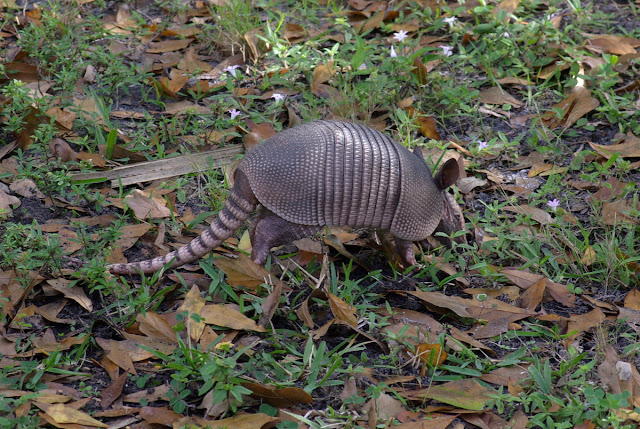
nine-banded armadillo (Dasypus novemcinctus)

nine-banded armadillo (Dasypus novemcinctus)

The little pink flowers visible in the armadillo pictures is large-flowered Mexican-clover (Richardia grandiflora), which is seen in close-up below. The plant is neither Mexican nor a clover. It is, in fact, from South America and is in the same family as coffee. It is now one of the most ubiquitous weeds of lawns, roadsides, parks, fields, and the disturbed portions of natural areas in Palm Beach County. It was first seen in Palm Beach County about 15 years ago and in that span of time its population has grown to such an extent that it is perhaps among the top 10 most common herbaceous, non-grassy perennials in the county. It was ever-present along the trails of the nature center and in one area its thick growth was shading a population of the small, native wildflower, Stenandrium dulce (pine pinklet).

Richardia grandiflora

The following pictures were all taken around the perimeter of the visitor's center, which is landscaped with both native and non-native butterfly garden plants. These plants were very effective as there were numerous butterflies, both small and large, visiting these plants that day.

Clerodendrum ugandense (blue butterfly plant), from Africa, was in full bloom. It is said to be a minimally invasive Clerodendrum, some of which are extremely aggressive in gardens due to an abundance of root sprouts. In many ways, it reminded me of the native blue curls, Trichostema dichotomum, on steroids, which is not surprising since both plants are in the mint family (Lamiaceae).

Clerodendrum ugandense

Clerodendrum ugandense

Clerodendrum ugandense

And here is an image of the native blue curls, Trichostema dichotomum, for comparison:

Trichostema dichotomum

Koanophyllon villosum was an interesting addition to the Okeeheelee County Park Nature Center butterfly garden. It is an endangered relative of the thoroughworts (Eupatorium species) and occurs in Florida, as a non-cultivated native plant, only in Miami-Dade County. It is unusual in being a woody shrub, most other related plants in Florida being herbaceous perennials. It bears innumerable tiny white daisies when in full bloom, at which time it is extremely attractive to nectar-seeking butterflies. Of additional interest is the aromatic foliage, which has an unusual mildly spicy scent or, in some forms, a slightly minty scent.

Koanophyllon villosum

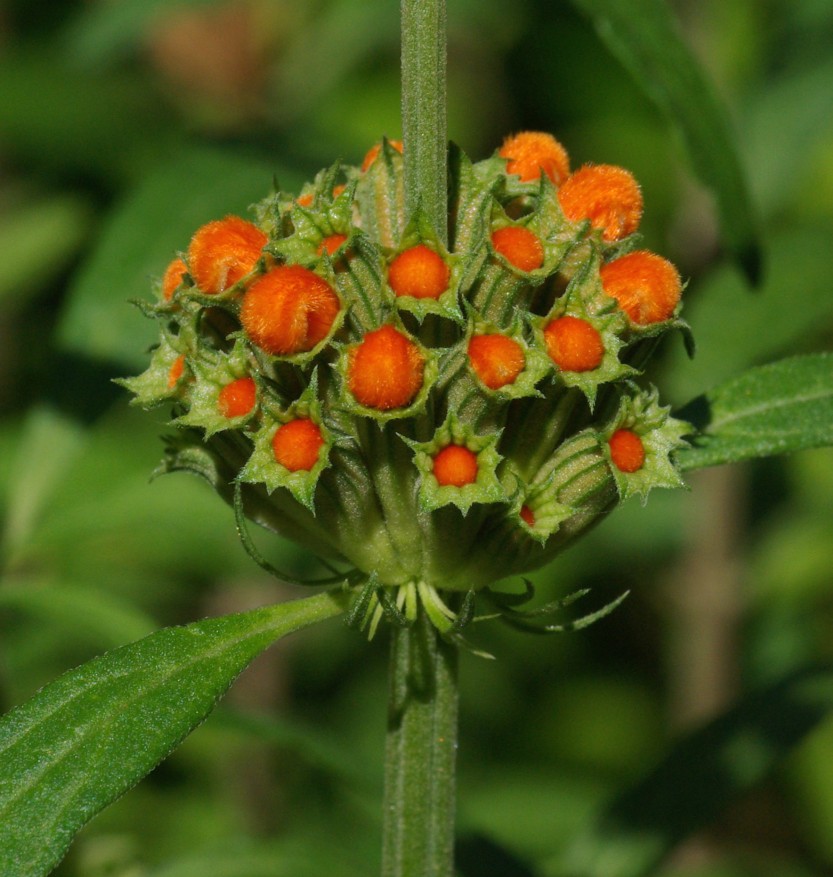
Around the corner from the Koanophyllon, and on the west side of the nature center, was a large clump of Leonotis leonurus, a plant native to Africa. Its bright orange flower buds were extremely attractive and eye-catching . . .

Leonotis leonurus

Leonotis leonurus

. . . but they opened into slightly dingy-orange flowers. Eagle-eyed readers might notice that the leaves above the flowers in the photo immediately below have crinkled edges. This is due to a viral infection. Such infections were rare in native plants but, as people bring cultivated virus-infected plants into close proximity with native plants, I am beginning to see native plants afflicted with viruses.

Leonotis leonurus

After the flowers have faded, they leave behind an interesting set of green calyces.

Leonotis leonurus

The aptly named fire-spike (Odontonema cuspidatum) from the American tropics grew in a large clump at the front of the nature center and it was visited by numerous brilliant yellow sulphur butterflies, none of which stood still long enough to be photographed. As one can imagine, the combination of yellow butterflies and bright red flowers created a very colorful scene.

Odontonema cuspidatum

Pentas lanceolata, is one of the most common butterfly garden plants in south Florida; however, I have seen insects visiting this plant exactly twice in 20 years. As usual, no butterflies were to be seen on the brilliant red pentas at the nature center on the day of my visit.

Pentas lanceolata

Golden polypody (Phlebodium aureum) grew in a large cabbage palm (Sabal palmetto) and its yellowing leaves provided a bit of "autumn" color on a warm subtropical winter's day. It is a very large fern with a dramatic presence and it is mostly ignored by Florida gardeners, perhaps because it is so common. Were it rare and endangered, it would surely be greatly sought after by plant collectors.

Phlebodium aureum

Tropical sage (Salvia coccinea was well-represented in the butterfly garden. This was, of course, no surprise since this native plant is a staple of South Florida butterfly gardens where it attracts both butterflies and hummingbirds. All three color forms—red, pink, and white—were present in the garden.

Salvia coccinea

Salvia coccinea

Another staple of butterfly gardens, and equally attractive to hummingbirds, is Sophora tomentosa (necklace pod). The plant in the image below clearly has leaves densely covered with tiny silvery hairs. This identifies it as the non-native var. occidentalis, whose native range is Texas and tropical America. The Florida native var. truncata has leaves that are hairless, or nearly so, at maturity. In the background, is firebush, Hamelia patens, another favorite of butterfly gardeners.

Sophora tomentosa var. occidentalis

Go to Part 2.

All images and text © 2010 Rufino Osorio.